From Product Curator to Lifestyle Advisor
A customer admires your collection, saves several products, but still leaves the showroom interested rather than ready to decide.
This is an increasingly common challenge, especially for premium furniture retailers and design firms. Individual pieces may attract attention, yet customers often struggle to picture how those products will work together in their own homes. Without a clear view of the complete space, uncertainty remains, decisions take longer, and opportunities to sell can easily be lost.
For years, a well curated collection has been a powerful source of differentiation. The right combination of brands, materials, and styles communicates what a business stands for. But great products are now easier than ever to discover. Customers arrive with saved images, product links, and ideas gathered from multiple platforms.
The challenge is no longer simply offering more choice. It is turning that choice into a clear, relevant vision for the customer’s space.
This is why the role of retailers and design firms is evolving beyond product selection. Customers increasingly expect businesses to show not only what to buy, but also how different products can come together in a way that suits their space, preferences, and lifestyle.
AI is evolving alongside this shift. Its role in the home furnishing industry is moving beyond generating inspiration or producing attractive images. The greater opportunity lies in connecting product data, customer preferences, and spatial information, and ultimately turning them into something useful during an actual sales conversation.
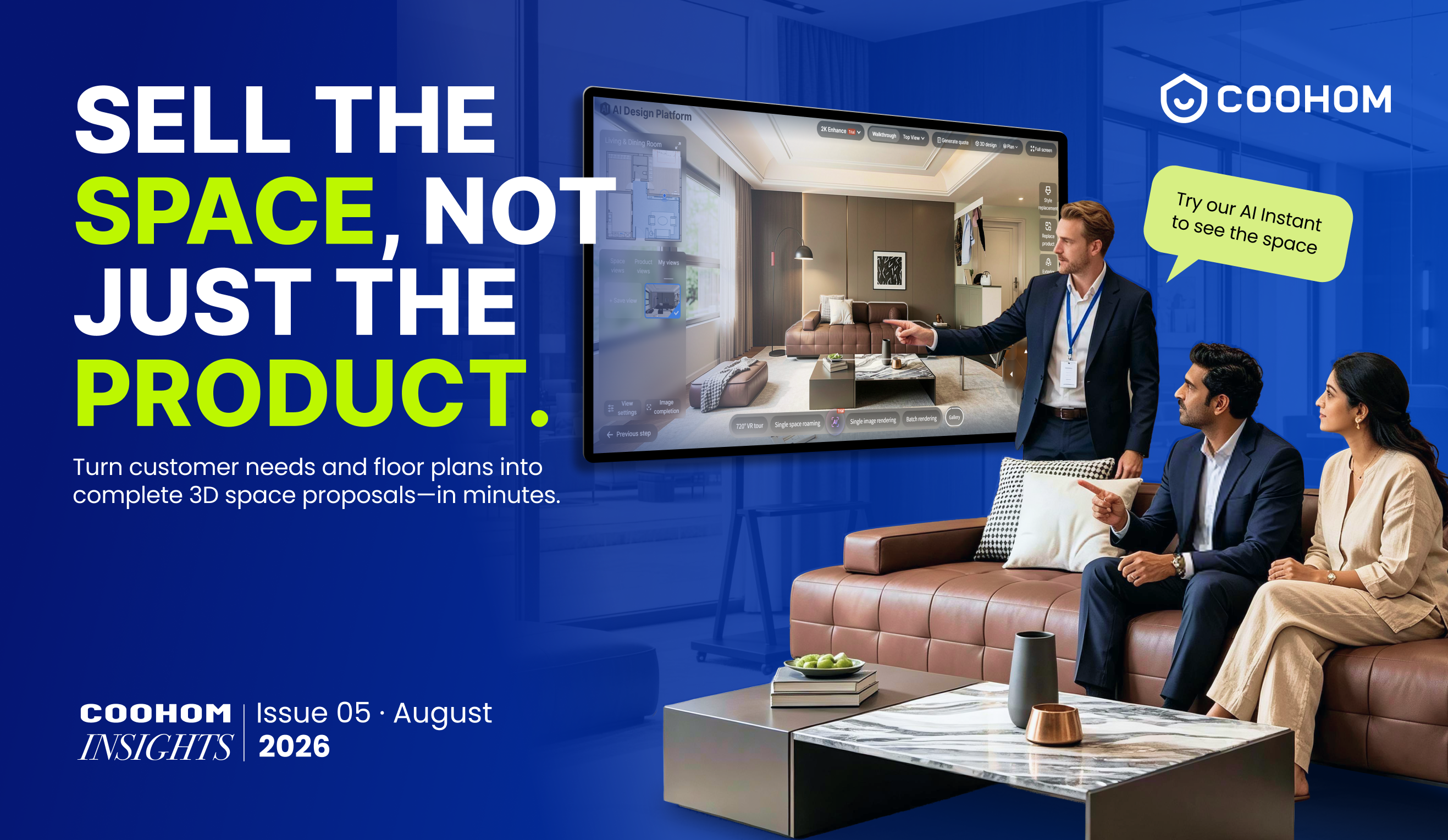
AI Instant supports this process by bringing the product catalog, customer requirements, and floor plan into one visual proposal. It helps sales teams transform a strong collection into a complete spatial direction that customers can understand, trust, and act on.
Great products remain the starting point. The competitive difference lies in how convincingly a business brings them together.
When the Catalog Starts Working Harder
How much of a premium furniture collection does the customer ever truly see? A showroom can present only a small part of the assortment, while the complete catalog may contain thousands of models, finishes, sizes, and configurations.
This creates a quiet gap across the industry. Brands and retailers have invested heavily in digital product assets, yet much of that value remains inside catalogs, internal libraries, and design systems. The products are there, but only a limited selection ever enters the customer conversation.
The next stage of digital transformation is not simply about creating more content. It is about making existing content more commercially valuable.
AI Instant can bring relevant products into the conversation based on the customer’s floor plan, functional needs, and preferred style. A piece that might otherwise remain hidden in the catalog becomes relevant because it now has a clear role within a broader spatial direction.
The digital catalog is no longer just a place where products wait to be discovered. It becomes an active sales resource that connects the right parts of the collection with each customer opportunity.
Putting Design Expertise Where It Creates the Most Value
How early should a business invest professional design resources in a customer who is not yet ready to commit? Premium furniture customers increasingly expect design support at the beginning of the purchasing journey. They want to see a credible direction early, while sales teams need something concrete to move the conversation forward.
This puts pressure on design resources. A customer may not yet have confirmed the budget, project scope, or intention to purchase, but a designer may already have spent hours developing an initial proposal. As inquiries increase, professional time can easily become concentrated on early production rather than the decisions that require genuine design judgment.
The question is not simply how to help designers work faster. It is how to use their expertise more effectively.
AI Instant can translate basic customer requirements and floor plan information into an initial direction for discussion. This helps the team understand whether a project is ready to move forward before deeper design work begins.
Designers can then focus on proportion, material relationships, customization, and technical feasibility. The future of design led retail is not about reducing the role of the designer. It is about applying professional expertise where it can create the greatest value.
Ready to Scale Your Brand?
Join the digital revolution with Coohom’s all in one platform. Contact us today for a personalized demo.