Kritagya’s story began with a bold career shift. He initially studied information technology, but his inner passion for innovation drove him to switch to design, where he spent three years earning a degree from a specialized design school in India.
However, as he entered the workforce, he quickly faced the harsh realities of the industry.
Endless Waits and Disappointment: The Darkest Hour of Early Career
As an intern, Kritagya found himself mired in the technical quagmire of traditional design software. At the time, he relied on SketchUp and V-Ray for his work, and every high-quality rendering required a grueling 40 to 50-minute wait.
This lengthy rendering process not only wasted his time, but the results were often unsatisfactory—the lighting and materials frequently had a cheap, “plastic” look that failed to accurately convey his design vision.
Unable to validate his proposals through 3D renderings, he felt a sense of frustration unlike anything he had experienced before.
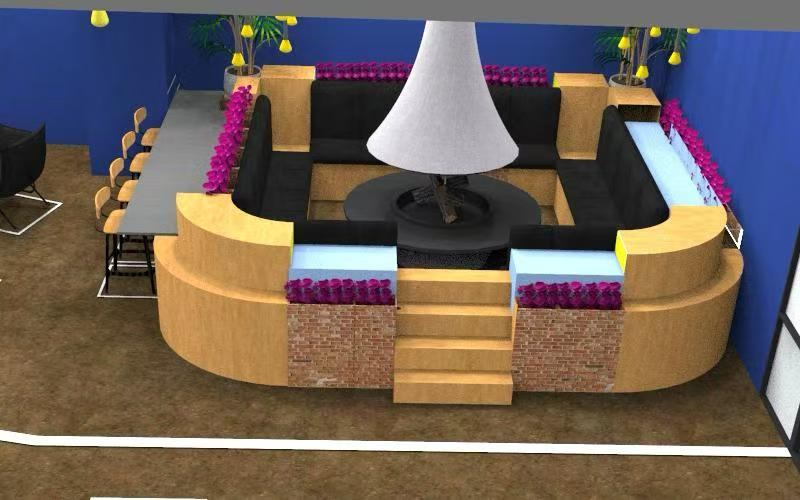
He still remembers his first internship at a design firm, where he was repeatedly criticized for his speed and quality. “Even though I had excellent design skills, I couldn’t effectively showcase my designs because the 3D work wasn’t up to par. When the lights came on, not all the surfaces and edges were flawless.”
His supervisors and clients were often disappointed in him and began to lose trust.
He still vividly remembers that disheartening night when he worked late, drove home, and called a colleague, his voice filled with frustration: “They don’t believe in my designs because my 3D rendering skills are so poor.”
The turning point
The turning point in his career came in 2023, when a friend introduced Kritagya to Coohom.
Determined to turn things around, he demonstrated remarkable perseverance, locking himself in his room for two consecutive nights and spending his off-hours studying and practicing all night long.
He recalls that in just three days, his rendering skills took a quantum leap, rising from virtually zero to 80% of a professional level. What surprised him even more was that Coohom, as a cloud-based design software, significantly lowered the hardware barrier—a godsend for design students and new professionals on a tight budget.
He no longer needed to purchase expensive, high-performance computers like his colleagues; even a standard laptop bought on the second-hand market allowed him to handle design tasks with ease, and he could complete rendering jobs that would normally take hours during his lunch break.
In the field of interior design, clients always want to see a “test rendering” first. For those using V-Ray or 3ds Max, even a test render requires at least 15 to 20 minutes of waiting.
With Coohom, that time is reduced to just a few minutes.
This massive efficiency advantage allowed him to quickly establish himself in the workplace; in just three months, he assisted in completing the 3D design work for five to six villas that had been backlogged at a company for a long time. Design revisions and renderings that once took 20 minutes to process can now be perfectly presented to clients in just one or two minutes.
Today, Kritagya has grown from that untrusted intern into a core member of a professional design firm, having independently completed as many as 88 design projects.

The Bridge of Design:May Every Design Talent Be Seen
Reflecting on this journey of growth, Kritagya likens Coohom to a “bridge” spanning a raging river, connecting the ideas in a designer’s mind with their real-world execution. He believes, “All of us want to be entrepreneurs—men and women alike—and we want to sell our ideas to others. But if you can’t truly show them what you’re thinking, it will be very difficult for you.”
Drawing from his own experience, Kritagya hopes that every Indian design student aspiring to succeed will utilize such an efficient tool to free themselves from the burden of hardware constraints and lengthy wait times, ensuring that talent is no longer limited by technical means.

“From the very first day I used Coohom, I wanted to teach it to every Indian student who dreams of becoming a designer,” he said with conviction.